
Most young people enter the workforce with very little experience or training in conducting meetings. We often hear complaining about meetings being a waste of time. “haven’t worked all day cause I was stuck in meetings”. How can we have efficient meetings and feel productive? Although meetings are a primary method of communication in projects, we often tend to overutilize them without considering other methods. (Feel free to use and customize the content in this blog for training your project teams.)
The first step is to identify the objective of the meeting. It will fall under one of the following categories:
- Information sharing (presentations, training, status update, corporate update)
- Task coordination
- Decision Making (decide strategies, assign tasks)
- Problem Solving (brainstorming, innovation)
- Workshop – complete task or document (report, test, plan, timeline)
- Team Building – goal to improve the way the team members work together
Is a Meeting Really Needed to Achieve Objective?
Meetings are interactive communication where 2 or more people communicate in real time. Out of the categories listed above, information sharing and coordination don’t automatically (and necessarily) require meetings. Status updates, for example, can be communicated by a push or pull methods. “Push” communication is sending out emails or memos, whereas “Pull” is the recipient accessing updated dashboard on the intranet, for example. During project communication planning, information sharing methods can be established with stakeholders, so they will know when and how to expect information. If required, recipients can acknowledge reception and give feedback. If questions, comments, and discussions are anticipated, then it would make sense to have an interactive meeting.
Define Type of Meeting
Meetings can be formal or non-formal, one-time or re-occurring. Some types are:
- 15min stand-up scrum: usually re-occurring daily team meetings to coordinate daily tasks. Minutes are usually not recorded and not necessary.
- Face to face conference: Typical and classical type of meeting. See below for detail process for formal conference meeting.
- Phone / video conferencing: Sometimes combined with Face-to Face, follows same process.
- Cooler talk / hallway talk / office drop-ins: Very informal but important communication types. Many decisions are made (or problems solved) this way. Too often, the issue is not recording the information and not widely distributing the minutes. PMs must keep track of, and manage the output of these communications.
- Instant messaging / message posting apps: Also very informal but important to record and widely communicate output.
Process for One-Time, Formal Meeting:
Formal meetings require significant preparation and execution effort. As discussed, there are often more efficient or lean communication methods but if a formal meeting is required the steps below describe the process.
- Prepare objective statement, agenda, presentation and meeting material.
- Determine attendees. Each attendee must have role for the meeting. For example, “.. required to approve decision on … “, or “ required to give opinion on … “ etc.. Some attendees may be required for the sole purpose of being informed because of impact to their work. Defining roles will make it easier to determine who to invite. Make sure the attendees know what is expected of them for the meeting so they come ready.
- Reserve location and send invites. If some are to logon via phone or video conference, make sure they have all instructions to do so. Send out all necessary info including agenda, meeting material, and assignments for readiness.
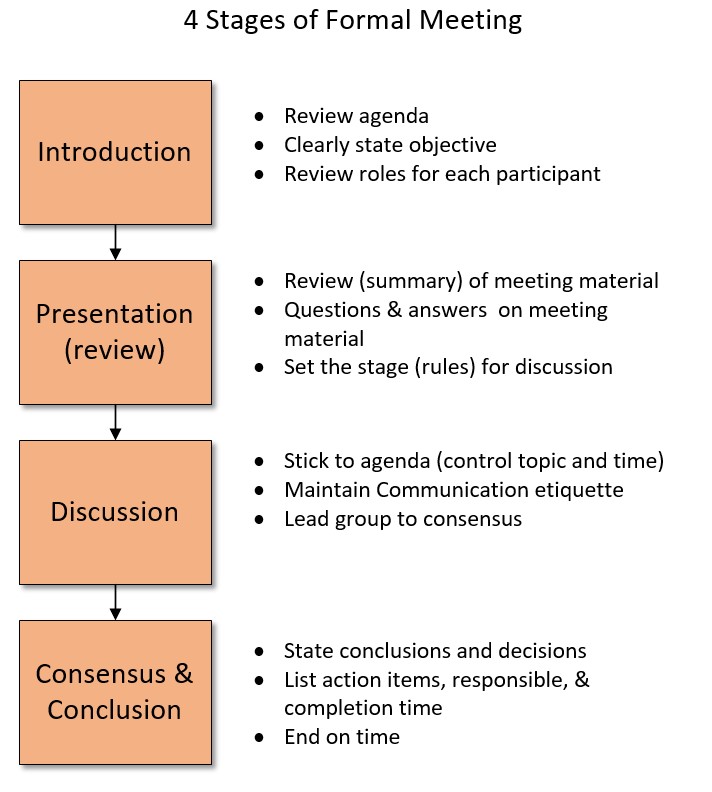
- Conduct Meeting. Most meetings can be divided into four stages: Introduction, Presentation, Discussion, Conclusion. The meeting facilitator should follow the guidelines in figure below. Additional points:
- Before the meeting starts, setup, troubleshoot, and check audio/visual and remote connections.
- Allow for a late start while waiting for attendees but set a maximum time limit (ex. 5 min).
- Assign a minutes-taker.
- Keep to the agenda and on topic. It is ok to kindly interrupt anyone who is straying off-topic.
- Focus on the goal by completing tasks, discussion points, and arriving at a consensus or conclusion.
- Closure: Complete and distribute the meeting minutes and follow up on any action items to completion. Complete and close the meeting record. The meeting record is form or an index containing everything specified below.
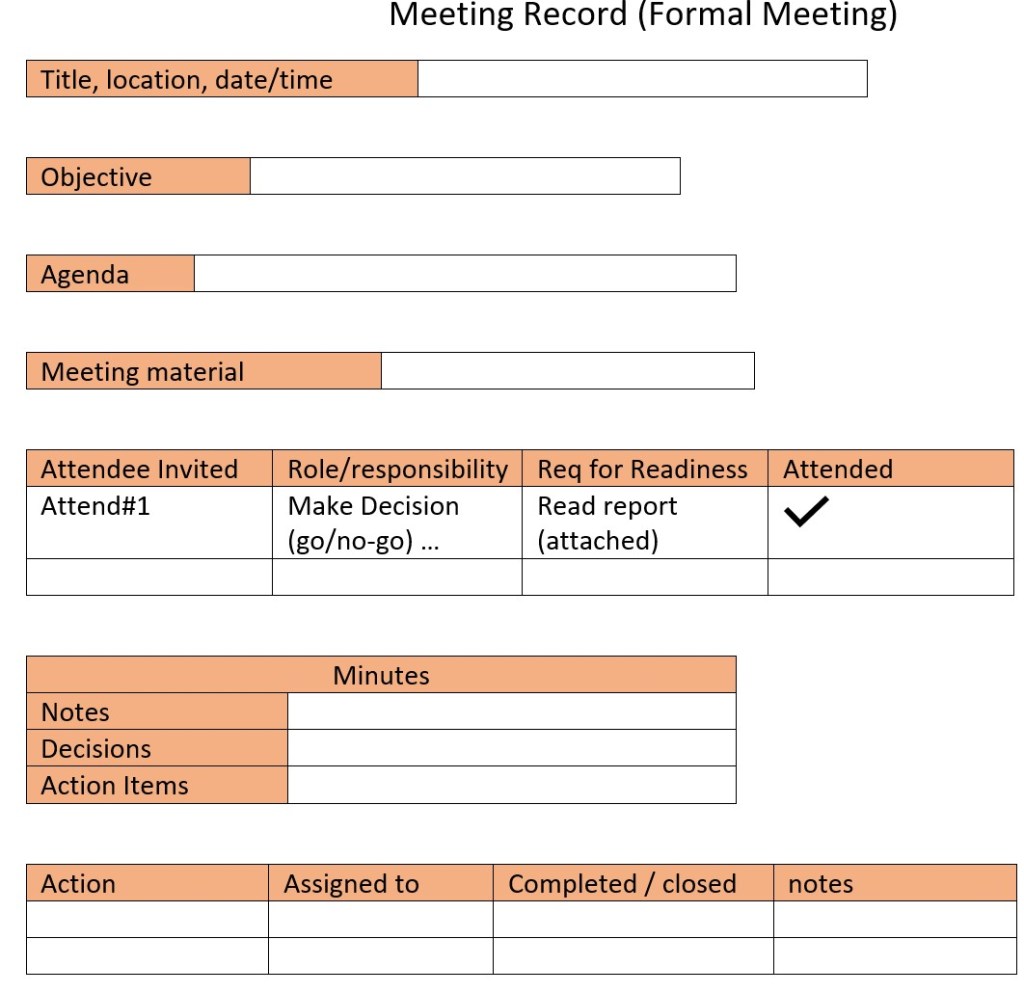
With the exception of stand-up scrum, all project meetings should have a written record. Keep in mind that all effort and time put in by the organizer and participants must ultimately result in the project or other business activity to MOVE FORWARD. If the meeting records end up filed in an online folder to be forgotten, then all that effort was in vain. For the meeting and its output to have purpose, it needs to be attached to a controlled process or project input/output (which moves the project forward). For example, the meeting record is attached to change order to justify a change, or appended to an engineering report, or justify new user requirements, etc.. The meeting now has business value and we will consider time spent in meetings as REAL work.
 Domenic Santoianni