
All would agree that effective communication is critical in business. In the medical device industry, bad communication can cause significant delays and expenses or even lead to wrong and unsafe devices being released. A product development plan typically consists of a communication section which defines the team, responsibilities, and describes the interfaces among stakeholders. This blog takes planning a step forward to focus on managing stakeholder engagement. Stakeholder engagement is the cornerstone of successful project management, which can only be achieved through proper communications planning. All too often, communication is taken for granted and is left up to experience and best effort. Why go through the process of planning?
- By going through the exercise of brainstorming and writing down communication methods, types, and processes, we become aware that communication is a skill and art which requires continuous attention, improvement, and optimization.
- Planning, as described below, establishes a metric to rate and improve stakeholder engagement.
Although the tools and techniques described below can be applied throughout all departments, the intended scope is for product development projects and programs. Also, communication management with regulatory bodies is its own beast, and outside the scope of this writing.
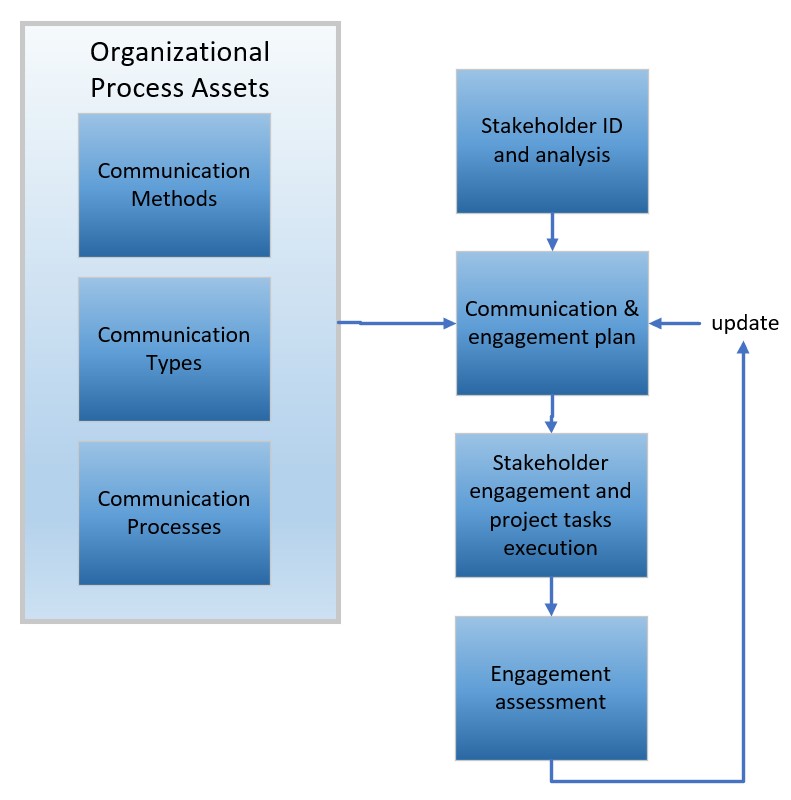
A summary of the process is shown in the figure below.
From the PMBOK guide, two knowledge areas to focus on are 1) Communications Management and 2) Stakeholder Management. Planning project communication and engaging stakeholders go hand in hand. Here are a couple of definitions:
Stakeholder: All people, groups, or organizations that could impact or be impacted by the project.
Stakeholder engagement: The process of communicating and working with stakeholders to achieve mutually agreed upon objectives.
The task of communication planning as described below can be daunting if one starts from scratch but most processes and techniques can be standardized at an organizational level. Organizational Process Assets (OPIs) are plans, processes, and policies which are put in place company-wide. OPIs to standardize communication methods, types, and processes should be established.
Communication Methods
Communication methods should be defined by the organization, as well as detailing instructions and guidelines on how to use the tools and facilities. Some examples of methods are:
- Interactive
- 15min standup scrum
- Face to face conference
- Phone / video conferencing
- Cooler talk / hallway talk / office drop-ins
- Instant messaging / message posting apps
- Push communication
- Notice boards / screens
- Social media (ex. Linkedin, FB, ..)
- Press-releases
- Letters, memos, reports, articles
Organizations should also define and standardize Project Management Information System (PMIS). It is important to define the tools that will be used to communicate including for example, video conferencing application, web sites, electronic drop boxes or servers, etc.. Planning these ahead of time will ensure that all stakeholders are aware and ready for the systems.
Communication Types
Selecting the type (reason for) communication sets the focus on the objective. Keeping communications focused and on one topic is the most efficient way. In product development projects, some examples of why we communicate are:
- Informing (presentations, training, status update, corporate update, announcements).
- Making a decision, correction, change, improvement (ex. by steering committee)
- Solving a problem
- Organize & coordinate tasks
- Completing a task
- Motivating / team building
- Negotiating to fulfill a project requirement
Communication process guidelines should include forms and templates and be integrated in PMIS as much as possible. Processes for formal design reviews, device risk management, and audits should be detailed in their respective SOPs.
Generate Stakeholder Communication and Engagement Plan
The first step is to identify all possible stakeholders that will be associated with the project. This is an extensive list which should be categorized based on criteria selected by the PM. A common method (as per the PMBOK guide) is to place stakeholders on Power/interest grid, power/influence grid, or impact/influence grid. The goal of grouping stakeholders is to identify communication requirements. Instead of a 2D grid, it may be easier to classify by required engagement frequency. For example, the core development team requires frequent communication on daily tasks, whereas upper management do not. An example of stakeholders list, and categorization thereof, for a medical device development project is shown below.
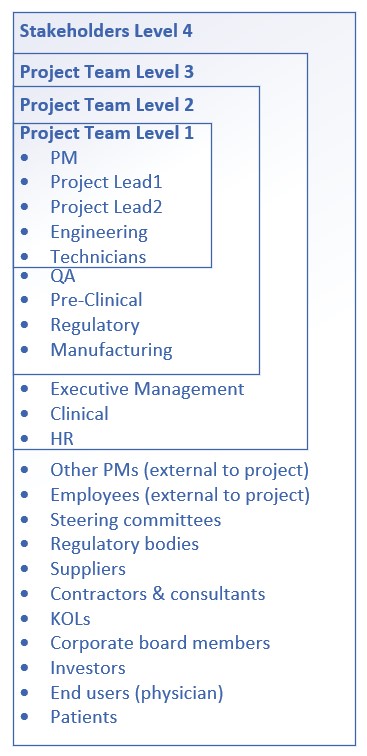
After identification and categorization, an analysis of each stakeholder is required to develop communication requirements. At a minimum, the plan should consist the following information.
- Stakeholder ID: Name, title, company, description and type of stakeholder
- Classification: As a result of stakeholder analysis, the classification can include level categorization as discussed above and/or some other criteria which helps the team establish relationship with the stakeholders
- Requirements: describes activity required by or with the stakeholder. Describes stakeholder’s role for the project.
- Communication Method
- Communication Type
- Timeframe and frequency
- Person responsible for the communication
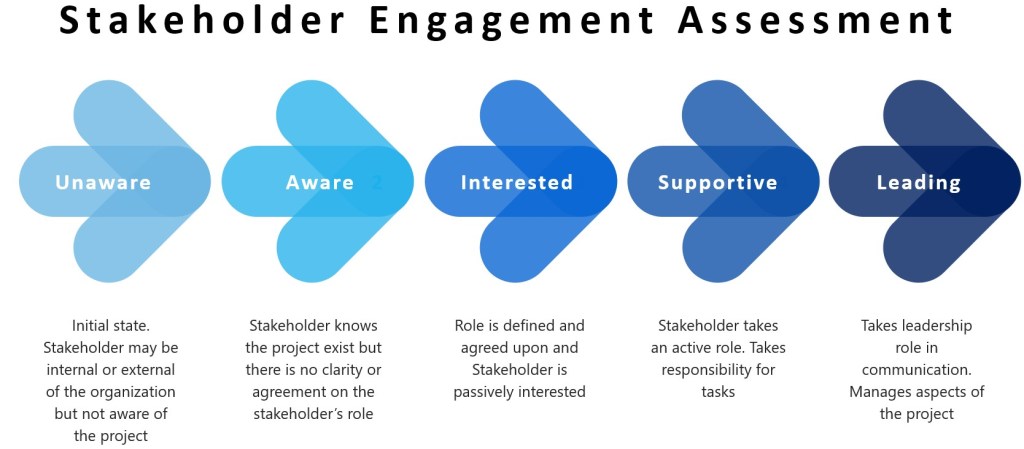
- Stakeholder engagement rating: see below
Rating the level of engagement allows the PM to assess the performance of communication and make adjustments during the project lifecycle. The objective is to ensure the project has all inputs and support it requires for success. The figure below is an example of classifying or rating stakeholder engagement (varies slightly from PMBOK guide):
The process detailed above describes how to manage stakeholder engagement and communication for a product development project. Implementing communication OPIs and investing time and effort managing these knowledge areas will reduce project risk.
 Domenic Santoianni
One thought on “Stakeholder Communication in Development Projects”